Waffle cones are widely used by ice cream shops, dessert manufacturers, food distributors, and frozen dessert companies. For businesses moving from manual preparation to commercial production, the key challenge is not simply baking a cone. The production process must deliver consistent color, crispness, shape, weight, and output.
Understanding the waffle cone production process helps manufacturers choose the right equipment, organize the production workflow, and reduce product defects.
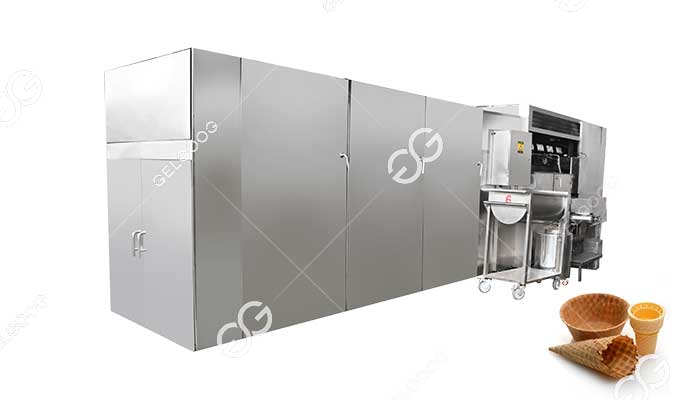
How Are Waffle Cones Made Commercially?
A typical commercial waffle cone manufacturing process has these main steps:
1. Batter Preparation
Mix ingredients like flour, sugar, eggs, oil/butter, and water into a consistent batter. Batter viscosity affects spreading, baking, color, and texture, so a repeatable recipe and steady feeding are key.
2. Baking
Dose batter onto heated plates that create the waffle pattern. Temperature and baking time must be stable—underbaking gives a soft, weak sheet, while overheating causes dark color, brittleness, or burning.
3. Forming
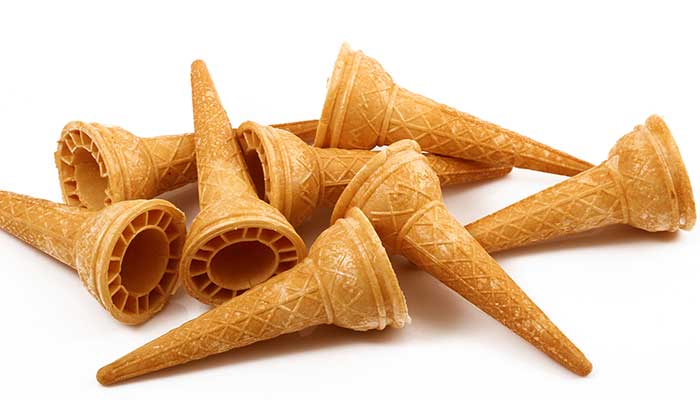
While still hot and pliable, the baked sheet is rolled around a mold into a cone shape. Quick, accurate forming ensures consistent diameter, length, and appearance; delays cause cracking or deformation.
4. Cooling and Setting
The cone cools and stabilizes, becoming crisp and holding its shape. Controlled conveying and cooling give more consistent results than manual handling.
5. Inspection and Packaging
Finished cones are checked for quality and then packaged.
What Equipment Is Needed for Commercial Waffle Cone Production?
A commercial production setup can include several connected stages:
- Batter mixing system
- Batter storage or feeding system
- Automatic dosing system
- Baking system
- Cone forming system
- Cooling conveyor
- Counting or inspection equipment
- Packaging equipment
For manufacturers looking for cone baking and forming equipment, the equipment configuration should match the required output, cone dimensions, heating method, available factory space, and packaging process.
A standalone machine may suit a smaller operation, while a connected production line can provide better process coordination for larger factories.

From Small Production to Industrial Manufacturing
The right production configuration depends on the company's business model.
A small ice cream shop may only require basic baking and forming equipment. A food manufacturer supplying multiple customers may need continuous production, automated conveying, counting, and packaging.
For factories planning an ice cream cone factory setup, it is useful to evaluate the complete workflow instead of selecting individual machines based only on price.
The goal is to create a stable production system that matches the required output, product specifications, labor availability, factory space, and future expansion plans.
Conclusion
A reliable waffle cone production process combines accurate batter preparation, controlled baking, fast forming, effective cooling, and consistent packaging. For commercial manufacturers, equipment should be selected according to actual capacity, product specifications, automation requirements, and future production plans.
By designing the process around these factors, manufacturers can achieve more consistent waffle cone quality while creating a production workflow that can scale with market demand.
 One-Stop Solution


