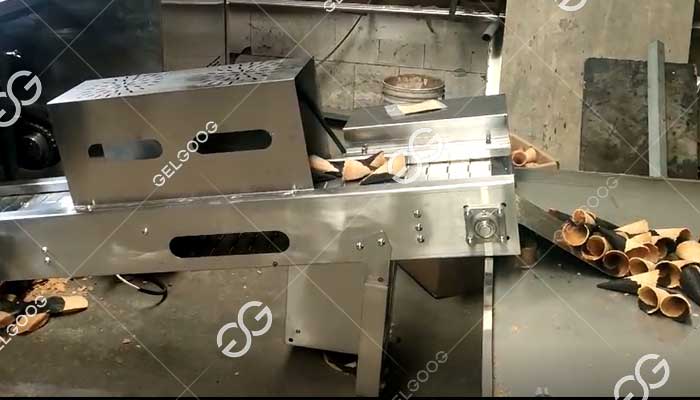
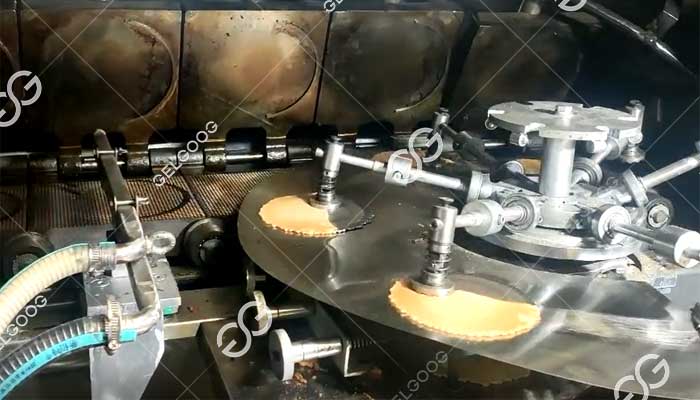
The demand for industrial sugar cone machines continues to grow as ice cream manufacturers, wafer producers, and food factories look for higher output, consistent quality, and lower production costs. Modern equipment can integrate batter filling, baking, forming, demolding, conveying, and stacking into a continuous production process.
One question is becoming increasingly important for buyers: industrial cone machine gas vs electric heating which is better?
The answer depends on factory energy costs, available utilities, production capacity, installation conditions, and long-term operating goals.
An industrial sugar cone machine is designed for continuous, high-volume production rather than small-batch or household use. Current industrial models can provide automated production and stable baking conditions, while different configurations can support different cone sizes and production requirements.
For example, the industrial sugar cone machine offered by us includes models ranging from 300 to 1,200 pieces per hour, with different power levels and cone specifications.
For factories expanding production, the main advantages include:
Higher production efficiency
More consistent cone thickness and color
Reduced manual labor
Automated baking and forming
Flexible cone size and mold options
Easier integration into a complete sugar cone production line
These features make the automatic sugar cone machine a practical choice for commercial ice cream and wafer cone manufacturers.
Industrial Cone Machine Gas vs Electric Heating: Which Is Better?
There is no universal winner between gas and electric heating. The better option depends on the factory environment.
1. Gas Heating for High-Volume Production
A gas heated sugar cone machine uses natural gas or LPG as the main heating source. Gas heating is often considered when a factory has reliable gas infrastructure and operates the equipment for long production hours.
Potential advantages include:
High heating capacity
Suitable for continuous production
Potentially lower energy costs where gas prices are favorable
A practical choice for high-capacity production lines
Some industrial wafer and cone machines use natural gas or LPG and are designed for thousands of cones per hour.
For factories with stable gas supply and high daily output, gas heating can be an attractive option.
2. Electric Heating for Flexible Installation
An electric sugar cone machine uses electrical heating elements to generate and control oven temperature. Electric systems can be easier to install in factories where gas infrastructure is unavailable or restricted.
Key advantages can include:
Straightforward utility connection
Precise temperature control
No on-site gas storage
Suitable for factories with reliable industrial electricity
Convenient for small and medium production facilities
Electric heating is also widely used in commercial and industrial cone-making equipment. Some manufacturers offer machines with either electric or gas heating depending on customer requirements.
Gas vs Electric Sugar Cone Machine Comparison
Factor
Gas Heating
Electric Heating
Initial installation
Requires gas system
Usually simpler
Energy source
Natural gas or LPG
Electricity
High-volume production
Excellent for suitable factories
Excellent with sufficient power
Temperature control
Stable with proper system
Highly convenient
Factory infrastructure
Requires gas availability
Requires sufficient electrical capacity
Best suited for
Large, continuous production
Flexible installation and controlled heating
Operating cost
Depends on local gas price
Depends on local electricity price
Therefore, when comparing industrial cone machine gas vs electric heating, buyers should calculate total operating cost rather than comparing only the machine price.
What About Sugar Cone Machine Price?
The sugar cone machine price varies significantly according to production capacity, automation level, mold configuration, heating method, and customization.
Recent industrial listings show that automatic sugar cone equipment can range from smaller commercial systems to high-capacity production lines costing substantially more.
Instead of asking only “How much does a sugar cone machine cost?”, industrial buyers should compare:
Production capacity per hour
Energy consumption per batch or hour
Labor requirements
Finished-product quality
Mold replacement and maintenance costs
Installation and after-sales service
This approach gives a more accurate picture of the machine's total cost of ownership.
How to Choose the Right Industrial Sugar Cone Machine
Production Capacity:
Estimates cones per hour and daily output. Match speed to factory size.
Heating Infrastructure:
Checks gas, LPG, or electrical capacity. Determines gas or electric heating choice.
Cone Specifications:
Defines diameter, height, thickness, shape, and pattern. Guides mold selection.
Automation Level:
Covers automatic feeding, baking, forming, demolding, conveying, and counting. Reduces labor and boosts consistency.
Final Takeaway
So, industrial cone machine gas vs electric heating which is better?
Gas heating can be a strong choice for high-volume factories with reliable and economical gas supply, while electric heating can be more convenient where electricity is readily available and installation flexibility matters.
The best industrial sugar cone machine should match your production capacity, factory utilities, cone specifications, and long-term operating costs.
For manufacturers comparing machine configurations, capacities, and technical specifications, see the Industrial Sugar Cone Machine page for detailed equipment information and available models.
 One-Stop Solution